Hyaluronic acid: the science of the molecule that holds water.
It is on every serum bottle and half the moisturisers in the aisle — but hyaluronic acid is not really an acid, and the famous claim that it holds a thousand times its weight in water deserves a closer look. Here is the molecule, drawn out, from its repeating sugar unit to why that structure behaves the way it does.
Contents
A sugar with a misleading name
Hyaluronic acid was first isolated in 1934, when Karl Meyer and John Palmer purified an unusually large polysaccharide from the vitreous humour of a cow’s eye. They named it from hyaloid, meaning glass-like or vitreous, and uronic acid, one of the sugars it contained.[1] The tidier modern term, hyaluronan, arrived in 1986 to reflect that at body pH the molecule exists as a salt, not a free acid.
Chemically it belongs to the glycosaminoglycans, or GAGs — a family of long, unbranched sugar chains that also includes chondroitin sulfate and heparin. Hyaluronan is the odd one out: it is the only GAG that carries no sulfate groups and is never modified after it is made.[2] That makes it the simplest member of the family, and the same chain is built faithfully whether the cell doing the building is human or bacterial.
The repeating disaccharide
Strip away the scale and hyaluronan is just one small unit repeated thousands of times. That unit is a disaccharide: two sugars joined together. The first is D-glucuronic acid (GlcA), which carries the carboxyl group that gives the molecule its charge. The second is N-acetyl-D-glucosamine (GlcNAc), the amino sugar. They alternate down the chain, linked by two different glycosidic bonds — a β(1→3) bond within each pair and a β(1→4) bond joining one pair to the next.[2]

Repeat that pattern up to about 25,000 times and you reach molecular weights between roughly five thousand and twenty million daltons.[3] A single molecule can stretch to the length of an average human cell — enormous by the standards of biochemistry, and the reason its physical behaviour matters as much as its chemistry.
Why the chain drinks water
Two features of that structure explain the hydration. First, every glucuronic acid contributes a carboxyl group that loses a proton at physiological pH, leaving the whole chain lined with fixed negative charges. Water is polar, so those anionic sites gather a shell of water molecules around them. Second, the chain is not a tidy rod. In solution it thrashes into a loose, expanded random coil that sweeps out a huge volume relative to its mass, trapping water inside that domain like a molecular sponge.
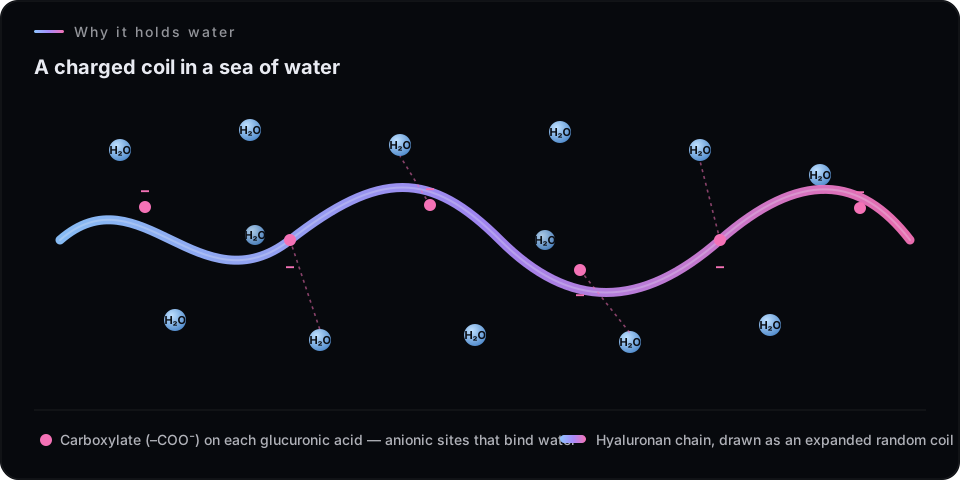
The result is a solution that is mostly water yet behaves like a gel — slippery, springy and resistant to compression. Those mechanics, not any mystical property, are what make hyaluronan a good lubricant and shock absorber inside the body and a humectant on the surface of the skin.
The “1,000× its weight” claim, examined
You will read everywhere that hyaluronic acid holds up to a thousand times its weight in water. It is a memorable number, and it is worth being honest about it. The figure is repeated across skincare marketing far more often than it is measured, and controlled tests on ordinary, non-crosslinked hyaluronan in water tend to land in the range of tens of times its weight, not thousands.[4] The higher numbers usually come from crosslinked gels or mixed solvents — useful materials, but a different thing from the molecule in a serum.
None of that makes hyaluronan a poor humectant; it is an excellent one. It simply means the honest version is more interesting than the slogan. As a studio that writes about evidence over decoration, we think the mechanism deserves more billing than the multiplier.
Where it lives: skin, joints and eyes
An average adult carries around fifteen grams of hyaluronan, and roughly half of it sits in the skin, where it fills the space between collagen and elastin fibres and keeps the dermis plump and resilient.[3] The rest lubricates joints, cushions the vitreous of the eye, and lines connective tissue throughout the body.
It is also strikingly dynamic. Rather than being laid down once, skin hyaluronan turns over continuously — its half-life there is less than a day, cleared and rebuilt on a rolling basis.[5] That constant renewal is why the enzymes that make and break it are of such interest to dermatology and regenerative medicine.
Reading an ingredient like a scientist
The useful habit here is the same one we bring to a client’s website: look past the claim to the mechanism underneath. Molecular weight, for instance, changes what hyaluronic acid can do — large chains sit on the surface and hold water there, while smaller fragments behave differently in the skin entirely. “Hyaluronic acid” on a label is a category, not a spec.
That is the same scrutiny we apply when we build in bespoke WordPress rather than stacked plugins, or when we trace how web technology actually evolved instead of taking the marketing version. If you want that kind of rigour applied to your own site or content, get in touch — we like a good molecule as much as a good brief.
References
Sources & further reading
- Hascall, V. C. (2002). The Discovery of Hyaluronan by Karl Meyer. Journal of Biological Chemistry. jbc.org
- Varki, A. et al. (eds). Hyaluronan. Essentials of Glycobiology, NCBI Bookshelf. ncbi.nlm.nih.gov
- Fallacara, A. et al. (2018). Hyaluronic Acid in the Third Millennium. Reviewed in PMC. pmc.ncbi.nlm.nih.gov
- On the water-retention figure and how it is measured across molecular weights. Hyaluronic acid overview, Wikipedia
- Kobayashi, T. et al. (2022). The Degradation of Hyaluronan in the Skin. PMC. ncbi.nlm.nih.gov